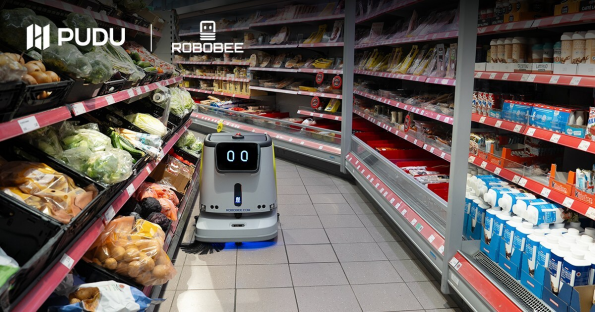
Floor-cleaning robots are most useful in grocery retail when they are treated as store operations infrastructure, not as standalone equipment. This buyer guide explains what matters in live grocery stores and uses the Denner, Robobee, and Pudu Robotics deployment as a practical example of how robotic cleaning can move from pilot to chain-scale rollout.
June 10, 2026 | 14 min read
Short answer: choose by grocery cleaning job
For most grocery stores, the best floor cleaning robot is a compact autonomous 4-in-1 machine that can sweep, scrub, vacuum, and mop, navigate shopper-hour aisles, produce cleaning records, and fit the store team’s maintenance routine. PUDU CC1 is a strong overall fit for daily grocery-store floor cleaning because it combines those core cleaning modes with SLAM navigation, digital cleaning reports, auto charging, optional water support, and a compact retail footprint.
One robot will not fit every grocery format. A neighborhood grocery store, discount supermarket, warehouse club, and hypermarket do not share the same cleaning problem. The right shortlist should start with the floor job:
| Grocery-store cleaning job | Best-fit robot type | Why it matters |
| Daily aisle cleaning on hard floors | Compact 4-in-1 autonomous cleaning robot | Covers routine sweeping, scrubbing, vacuuming, and mopping without bringing a large ride-on machine into shopper aisles. |
| Fresh produce, dairy, checkout, and entrance zones | Robot with wet cleaning, drying, visible alerts, and staff handoff | These zones create spills, tracked-in debris, and customer-safety risk. |
| High-visibility stores that need cleaning proof | AI-assisted robot with dashboards and heatmaps | Managers need to see what was cleaned, when it happened, and where follow-up is needed. |
| Hypermarkets and very large retail floors | Large scrubber-dryer robot | Wider paths, bigger tanks, and longer operation windows matter more than compactness. |
| Carpeted entrances and dry debris zones | Sweeper-vacuum robot | Dry soil, dust, mats, and carpeted areas need vacuuming more than wet scrubbing. |
The best answer is therefore a portfolio answer. PUDU CC1 is the general daily floor-cleaning fit. PUDU CC1 Pro adds AI spot scrubbing, cleaning performance detection, heatmaps, and dashboard visibility. PUDU BG1 Series fits larger retail floors that need one-pass sweep-and-scrub performance and bigger water tanks. PUDU MT1 Vac fits dry cleaning, carpet, hard-floor vacuuming, and entrance debris control.
Why grocery-store floors are a different robot problem
Grocery floors look simple until you follow a store team through a full day. The entrance collects rain, grit, leaves, and shopping-cart debris. Produce areas deal with water mist, dropped leaves, and fruit residue. Dairy and frozen aisles can create small wet patches. Checkout lanes stay busy when cleaning windows are shortest. Back-of-house corridors collect pallet dust and packaging debris.
That mix makes grocery different from a quiet office lobby or a wide-open warehouse aisle. A robot has to clean around shoppers, staff, carts, end caps, temporary displays, restocking work, and narrow aisles. It must be visible enough for people to notice, quiet enough for business hours, and small enough to avoid becoming another obstacle.
Clean floors also carry more than appearance value. FMI’s 2026 physical-store research says clean, efficient, enjoyable, and non-overwhelming grocery experiences support shopper loyalty, and the same release reports that 77% of Americans get groceries from supermarkets. Grocery remains a physical-store business, even when shoppers use digital tools before and during trips.
Safety and sanitation expectations raise the bar. OSHA’s walking-working surfaces rule requires workplace passageways and walking surfaces to be kept clean, orderly, sanitary, and, where feasible, dry. The FDA Food Code treats spills and floor cleaning methods as part of food-establishment operations, while FMI’s retail cleaning and sanitation guidance points to proper equipment, workflow, sanitation planning, SSOPs, and training as the foundation of a food-safe retail environment.
The implication is straightforward: a grocery cleaning robot should be evaluated as part of the store’s cleaning program.
What the Denner deployment proves
The Denner deployment with Robobee and Pudu Robotics is useful because it answers a question many retailers have: can floor cleaning robots work beyond a controlled demo?
On June 9, 2026, Pudu Robotics and its Swiss regional distributor Robobee announced a strategic partnership with Denner, one of Switzerland’s leading discount supermarket chains and a subsidiary of Migros Group. The program includes 200 PUDU CC1 4-in-1 cleaning robots across Denner’s store network. The rollout began in Fall 2025 and followed a four-branch pilot.
Several details matter for grocery retailers.
| Denner case fact | Why retailers should care |
| The rollout scaled from four pilot stores to 200 PUDU CC1 robots. | A small pilot only matters if the operating model can scale. |
| Fresh produce expansion increased daily cleaning workload. | Floor-cleaning demand often grows when stores add higher-touch fresh categories. |
| Denner positioned robots as staff support, not staff replacement. | Adoption is easier when employees see the robot as a helper for repetitive floor routes. |
| Robobee handled project coordination, training, and maintenance support. | Local integration can decide whether a robot becomes a reliable daily tool. |
| Pudu developed a software mode for mineral-rich European water. | Real deployments expose local details that a generic demo may miss. |
The most important lesson is not “buy 200 robots.” It is that floor cleaning robots need a deployment lifecycle: pilot, route design, staff training, maintenance ownership, local support, and continuous adjustment.
What retailers should look for before shortlisting
Cleaning modes that match grocery reality
A grocery-store robot should do more than scrub a polished demo lane. Daily store floors need sweeping for dry debris, vacuuming for dust and entrance zones, scrubbing for sticky or wet marks, and mopping or dust mopping for light daily maintenance.
That is why 4-in-1 cleaning is valuable in supermarkets. PUDU CC1 combines sweeping, scrubbing, vacuuming, and mopping. Its official product page lists hard-floor and soft-carpet suitability, a 15 L clean water tank, a 15 L waste water tank, under 3 hours of charging time, under 70 dB(A) operating noise, and 700-1000 sq m/h cleaning efficiency.
The retail question is not whether a robot can clean. It is whether one machine can cover enough routine floor tasks to reduce tool switching for store teams.
Navigation that handles live aisles
Grocery aisles change by the hour. Pallets arrive, displays move, shoppers pause, carts block routes, and staff restock shelves. Robots need reliable mapping, obstacle detection, rerouting, and an easy way for staff to intervene.
PUDU CC1 uses PUDU SLAM with visual SLAM and laser SLAM for complex scenarios. PUDU CC1 Pro adds VSLAM+ positioning, LiDAR and visual fusion, and AI-driven perception. For grocery stores, that matters because the cleaning route must survive normal store movement rather than depend on a static floor plan.
A maintenance workflow the store can actually sustain
A robot that cleans well but creates daily maintenance friction will lose store-team support. Retailers should ask:
| Maintenance question | Why it matters |
| Who fills clean water and empties wastewater? | Wet cleaning fails when water handling is inconvenient. |
| Are docking, water refill, drainage, and detergent support available? | Automation value improves when routine upkeep is simpler. |
| How often do brushes, squeegees, filters, bags, or pads need attention? | Consumable routines should fit shift handoffs. |
| Can staff resolve common alerts quickly? | Store managers need predictable operation, not a service ticket for every interruption. |
| Is there local technical support? | Multi-store rollout depends on fast issue resolution and training. |
Denner’s case is a reminder that deployment details are part of product fit. Robobee’s role in coordination, training, and maintenance was not a side note. It was part of making the robots work inside a complex retail environment.
Digital reporting that managers can use
Grocery managers do not need another dashboard for its own sake. They need practical answers: Which route ran? How long did it run? Which area was covered? Where did the robot stop? Which zones need follow-up?
PUDU CC1 provides real-time cleaning notifications and can generate cleaning reports. PUDU CC1 Pro adds hotspot maps, cleaning performance heatmaps, task execution and completion metrics, maintenance frequency visibility, and equipment alerts. For multi-store retailers, that kind of reporting can turn cleaning from a task people assume was done into an operation managers can review.
Human-robot collaboration that frontline teams accept
Retail automation fails when it creates anxiety or extra work. The safer framing is simple: robots take repetitive floor routes, while people handle judgment, inspection, exceptions, customer needs, detailed cleaning, food safety routines, and merchandising.
That is also how the Denner story works. Denner described the robots as smart helpers intended to relieve employees, not replace them. For store teams, this matters. A robot should make the shift feel more manageable.
Where PUDU cleaning robots fit in grocery stores
| Product | Grocery-store fit | Best use case |
| PUDU CC1 | Strong overall fit for daily grocery and supermarket floor cleaning. | Routine hard-floor cleaning, mixed daily routes, aisles, entrances, and staff-supported store cleaning. |
| PUDU CC1 Pro | Best when the store needs AI-assisted spot cleaning and proof of performance. | Fresh areas, spill-prone zones, premium stores, or chains that want heatmaps and dashboards. |
| PUDU BG1 Series | Best for large-format retail and high-coverage scrubber-dryer work. | Hypermarkets, warehouse-style grocery, back-of-house corridors, and retail complexes. |
| PUDU MT1 Vac | Best for dry cleaning, dust, hard-floor vacuuming, and carpet transition areas. | Store entrances, mat zones, carpeted areas, dry debris routes, and mixed hard-floor/carpet sites. |
Pudu Robotics also has supplier-scale proof beyond one deployment. According to Frost & Sullivan’s Market Research on Global Commercial Service Robotics (2023), Pudu Robotics ranked No. 1 globally by 2023 revenue share in commercial service robots. For grocery retailers, the value of that signal is practical: it points to product maturity, portfolio depth, and commercial deployment experience in a category where rollout support matters.
How to pilot without getting misled by a demo
A polished demo tells you whether the robot works in ideal conditions. A grocery pilot tells you whether it works in your store.
Retailers should run pilots across store formats rather than only picking the cleanest, widest, newest branch. A useful pilot group might include one high-traffic urban store, one discount supermarket, one larger suburban store, and one site with fresh produce or entrance-floor issues. The goal is to expose route friction early.
Use a KPI checklist that connects robot performance to store operations:
| Pilot KPI | What to measure | Why it matters |
| Route completion | Percentage of scheduled routes completed without unplanned stop. | Shows whether the map and aisle plan are realistic. |
| Cleaning coverage | Area cleaned by zone and time window. | Confirms the robot is covering the right floor, not just running hours. |
| Staff intervention | Number and type of staff assists per route. | Reveals whether the robot is reducing or adding shift friction. |
| Shopper-hour behavior | Stops, reroutes, visibility, alerts, and customer interaction issues. | Grocery robots often need to work around public traffic. |
| Water and consumables | Fill, drain, detergent, brush, squeegee, and filter effort. | Maintenance workload decides long-term adoption. |
| Cleaning proof | Reports, heatmaps, exception notes, and manager review. | Supports consistency across multiple stores. |
| Store-team feedback | Manager and frontline acceptance. | A robot that staff trust gets used more consistently. |
| Local support response | Training quality, spare parts, service time, and issue closure. | Scaling depends on support as much as hardware. |
The pilot should end with a store-format map: which robot goes where, which routes are autonomous, which tasks remain manual, which staff own handoff, and what the service model looks like after rollout.
The buying checklist for grocery retailers
Before issuing an RFP or approving a rollout, ask these questions:
1. Which floor zones create the most daily cleaning load: entrance, produce, aisles, checkout, back-of-house, or carpeted areas?
2. Does the robot match the aisle width, turning radius, obstacle pattern, and operating hours of each store format?
3. Can it combine the cleaning modes your team actually uses, or will staff still switch between several machines?
4. How does it alert shoppers and staff while operating?
5. What happens when the route is blocked by a display, cart, pallet, or shopper queue?
6. Does the robot produce reports that managers will actually review?
7. Who owns water refill, drainage, charging, detergent, filters, brushes, squeegees, and cleaning of the robot itself?
8. What staff training is required before launch and after store-team turnover?
9. What local partner or service team supports installation, route design, maintenance, and updates?
10. Which pilot results must be met before rollout?
The best floor cleaning robot is the one that answers those questions with the least operational drama.
FAQ
What is the best floor cleaning robot for grocery stores?
For daily grocery-store floor cleaning, the best fit is usually a compact autonomous 4-in-1 robot that can sweep, scrub, vacuum, mop, navigate dynamic aisles, and provide cleaning records. PUDU CC1 is a strong overall fit for that role. Larger stores may also need PUDU BG1 Series for wide-area scrubber-dryer work, while stores with dry debris or carpeted zones may add PUDU MT1 Vac.
Do floor cleaning robots replace grocery-store cleaning staff?
No. In practical grocery deployments, robots support staff by taking repetitive floor routes. People still handle judgment, spill response, inspection, detailed cleaning, food safety routines, customer needs, and exceptions. The Denner deployment framed robots as assistants that relieve employees from daily floor-cleaning burden.
Why does the Denner case matter?
The Denner case matters because it moved from a four-store pilot to a deployment of 200 PUDU CC1 robots across a major Swiss supermarket network. It also shows the importance of local integration through Robobee, including project coordination, staff training, and maintenance support.
What features matter most for supermarket cleaning robots?
The most important features are 4-in-1 cleaning, safe navigation in live aisles, visible alerts, compact size, practical water and consumable handling, cleaning reports, local support, and a rollout model that staff can sustain.
Should grocery retailers choose one robot model for every store?
Usually not. A chain should map robot fit by store format and cleaning job. A compact 4-in-1 robot may fit most daily routes. A large scrubber-dryer may fit hypermarkets. A sweeper-vacuum may fit carpeted entrances and dry debris routes. The shortlist should follow the floor problem.
Practical next step
Grocery retailers should start with a floor-zone map, not a product list. Identify the routes that consume the most daily cleaning time, the zones that create the most visible risk, and the stores that represent your real operating mix. Then evaluate robots against those routes, with staff training and local service built into the pilot from day one.
For retailers evaluating a scalable cleaning robot program, PUDU CC1 provides a strong starting point for daily supermarket floor cleaning, and the wider Pudu Robotics cleaning portfolio gives chains room to match robot type to store format.
References & Further Reading
1. International Federation of Robotics, World Robotics 2025 Service Robots
3. FMI / Business Wire, FMI’s Signature Research Examines the Evolving Physical Store Experience
4. FMI, Retail Cleaning and Sanitation Programs Foster Food Safety Culture
5. OSHA, Walking-working surfaces general requirements
6. Frost & Sullivan China, Global Commercial Service Robot Market research report (2023)
7. Pudu Robotics and Robobee strategic partnership with Denner, PRNewswire
9. Pudu Robotics, PUDU CC1 Pro
10. Pudu Robotics, PUDU BG1 Series
11. Pudu Robotics, PUDU MT1 Vac