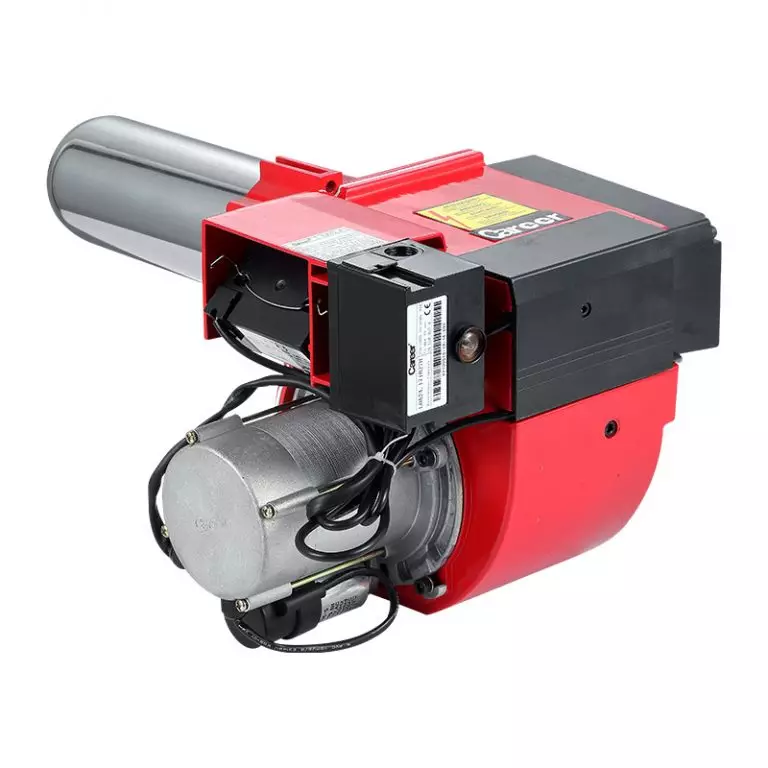
Choosing an oil burner for a furnace is primarily a matching exercise. The burner has to provide enough heat, work with the available fuel, fit the furnace, and operate in a way that suits the equipment’s load. A model that seems attractive with a high efficiency claim or large output can still be unsuitable if its firing range, control method, or installation arrangement does not match the furnace.
A reliable selection starts with the furnace itself. Its thermal demand, fuel, combustion chamber, control system, and physical interface should define the burner specification rather than the other way around.
What Furnace Information Should Be Checked Before Selecting a Burner?
The first step is to document the furnace’s operating requirements. Rated heat input, normal operating temperature, fuel type, chamber dimensions, existing burner arrangement, and available fuel pressure or supply conditions provide the basic information needed for comparison.
A furnace that runs continuously at a relatively stable load has different requirements from one that repeatedly moves between low and high firing conditions. Production schedules and heat-up cycles can reveal how much adjustment the burner actually needs.
Physical details are equally important. Mounting dimensions, burner opening, insertion depth, available service space, and the position of the combustion head should be measured before a replacement is selected.
Career Burner’s published oil-burner range covers light oils including diesel, kerosene, and Bio 10 oil. The collection spans 24 kW to 1416 kW, with fuel capacity from 0.75 GPH to 35 GPH, giving buyers multiple capacity and configuration options to compare.
How Should Burner Capacity Match Furnace Heat Demand?
Burner capacity should be matched to the furnace’s actual thermal requirement rather than selected from maximum output alone. The maximum firing rate needs to cover peak demand, but the burner must also operate appropriately at the lower loads experienced during normal production.
An excessively large unit can create a mismatch if the furnace cannot effectively use its minimum firing rate. Repeated cycling may then become necessary. A unit that is too small has the opposite problem: it may not supply enough heat to achieve the required furnace temperature or recover from process heat losses.
The furnace’s heat demand should therefore be compared with the burner’s complete operating range. Historical operating data can be especially useful because nameplate capacity does not necessarily represent the load encountered throughout a production cycle.
Career Burner lists both single-stage and two-stage regulation within its light-oil collection, along with on-and-off and modulation-control options. The control arrangement should be selected according to the furnace’s load pattern and temperature-control requirements.
Which Fuel and Control Configuration Should Be Selected?
Fuel compatibility should be confirmed before evaluating individual models. The available liquid fuel must correspond with the burner’s specified fuel range, while the fuel-delivery system must provide the conditions required for reliable operation.
A furnace already equipped for light-oil combustion may make a compatible oil-fired replacement relatively straightforward. However, fuel type alone does not determine suitability. Fuel quality, supply conditions, and the burner’s required operating range also need to be considered.
Control configuration is the next decision. An on/off arrangement may suit equipment with relatively simple firing requirements. Two-stage operation provides defined firing levels, while modulation can offer more continuous adjustment where the furnace needs closer control of heat input.
The term furnace oil burner should not be treated as a single equipment category. Different models can have substantially different firing and control characteristics even when they are intended to burn similar liquid fuels.
How Can Physical and Combustion Compatibility Be Verified?
A burner must physically fit the furnace while producing a flame suitable for its combustion chamber. Mounting compatibility should be checked alongside combustion characteristics rather than handled as a separate afterthought.
The burner opening, mounting flange, combustion-head position, insertion length, and available chamber volume can all affect installation. Flame length and shape also need to be appropriate for the furnace so that combustion takes place in the intended zone.
Air supply deserves the same attention. Combustion requires the correct relationship between fuel and air, so the furnace installation must provide suitable conditions for the selected burner. Existing fans, dampers, ducting, and controls may need to be evaluated as part of a replacement project.
An oil furnace burner should be assessed as part of the complete furnace system. Matching only the mounting dimensions or rated kilowatt output does not establish combustion compatibility.
What Should Be Checked Before Finalizing the Burner?
Before placing an order, the furnace operator or engineering team should assemble the equipment data and compare it directly with the burner specification. At minimum, the review should cover fuel type, required heat input, operating range, control method, mounting arrangement, combustion space, and available utilities.
Manufacturer guidance can help resolve questions that cannot be answered from a catalog page. Career Burner states that its oil-burner collection can be customized for fuel type, output range, control systems, and installation styles, which is relevant when an existing furnace does not align neatly with a standard configuration.
Commissioning requirements should also be considered before selection. After installation, fuel delivery, air adjustment, ignition, flame supervision, and firing control need to work together. The manufacturer advises correct air-to-fuel adjustment, clean filtered fuel, regular maintenance, and adherence to specified temperature, pressure, and safety settings.
Career Burner’s published range also includes models designed for boilers and industrial applications, illustrating why the connected equipment should remain central to model selection rather than treating all oil-fired systems as interchangeable.
The right selection can ultimately be reduced to a practical sequence: establish the furnace’s real heat demand, confirm the available fuel, identify the required firing control, verify the physical and combustion interface, and then compare suitable burner models. That process prevents maximum capacity from becoming the only selection criterion.
For furnace operators, the best burner is not necessarily the largest or most feature-rich model. It is the configuration whose capacity, fuel requirements, control behavior, and combustion characteristics correspond closely with the furnace’s actual operating conditions. A systematic equipment-first assessment provides a much stronger basis for choosing a reliable oil-fired combustion system.