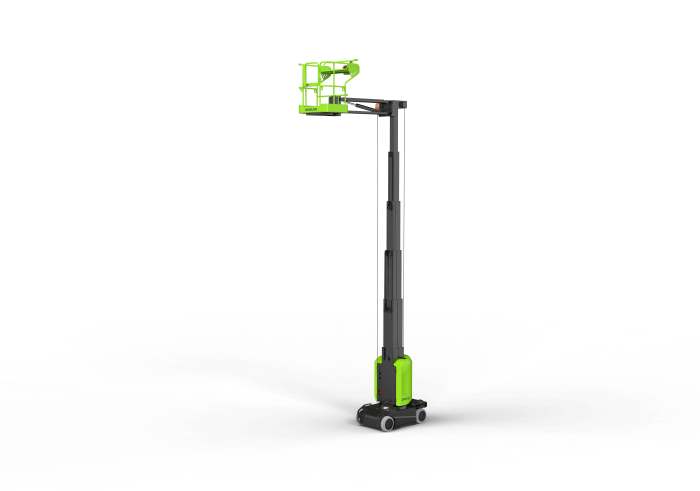
Overhead signage installation and interior maintenance often require technicians to work above busy floors, fixed equipment, or finished surfaces. For facility managers, contractors, and rental companies, selecting suitable access equipment is essential for balancing worker safety, positioning accuracy, and operational efficiency. A vertical mast lift can provide a practical solution for reaching elevated work areas where ladders are inconvenient and larger access platforms may be difficult to maneuver.
Why Vertical Access Equipment Suits Interior Work
Retail stores, shopping centers, warehouses, hotels, and commercial buildings frequently require work at height. Typical tasks include installing illuminated signs, replacing ceiling fixtures, inspecting ventilation outlets, and servicing overhead cables. These jobs may involve repeated adjustments and the handling of tools, fasteners, or small components.
A mobile elevating work platform allows workers to perform such tasks from a designated platform rather than repeatedly climbing and repositioning a ladder. Compared with larger boom equipment, compact vertical access machines can be particularly useful in locations with restricted floor space and narrow working areas.
The appropriate equipment depends on ceiling height, available floor space, required reach, floor conditions, and the number of workers involved. Contractors should also consider access routes, door clearances, and the equipment’s permitted working environment before making a purchasing decision.
Choosing a Vertical Mast Boom Lift for Signage Installation
Signage projects require more than sufficient elevation. Installers must align mounting brackets, position panels accurately, connect electrical components where authorized, and secure the finished installation. A stable working position and convenient access to the installation area can help reduce unnecessary repositioning.
A vertical mast boom lift may suit projects where workers need to reach elevated points within a relatively compact footprint. However, buyers should distinguish between platform height, working height, and horizontal outreach when comparing models. These measurements describe different capabilities and should not be treated as interchangeable.
For example, signage installed above a checkout area may require primarily vertical access, while a sign positioned behind fixed shelving could demand additional horizontal reach. The machine should be selected according to the actual work geometry rather than height alone.
Evaluating the Zoomlion Access ZMP09J
Zoomlion Access offers the ZMP09J as part of its vertical mast lift range. Its published specifications make it a candidate for contractors evaluating equipment for elevated interior work and selected signage applications.
Key specifications include:
Listed platform height: 11.2 m
Platform height-elevated dimension: 9.2 m
Platform height-stowed dimension: 3.23 m
Platform capacity: 200 kg
Machine weight: 2,990 kg
These figures should be checked against the manufacturer’s current technical documentation when planning a project, particularly because height labels may differ across product listings. The rated capacity must account for the combined weight of workers, tools, and materials.
The published data also lists a 0.76 m overall length, 0.99 m overall width, and 2.7 m platform width under its respective dimensional labels. Buyers should confirm the diagram’s measurement definitions before using these values to assess doorway clearance or transport arrangements.
Maneuverability, Capacity, and Floor Conditions
Working indoors often means navigating around merchandise, desks, partitions, and other equipment. Turning radius, overall dimensions, drive controls, and travel speed can therefore influence daily productivity. The ZMP09J specification sheet lists an inside turning radius of 0.2 m and an outside turning radius of 1.61 m, alongside proportional controls. These features are relevant when assessing movement through confined work areas.
Capacity is equally important. A 200 kg platform rating does not mean that workers can carry 200 kg of materials in addition to their own weight. The combined load must remain within the manufacturer’s limit, with tools and installation components included.
Floor suitability also requires attention. Although equipment may be designed for indoor use, its weight can affect floor loading, particularly on raised floors or other surfaces with structural restrictions. Operators should check the floor’s load capacity, the manufacturer’s operating limits, and any site-specific restrictions before elevating the platform.
Safety and Operational Planning
Safe access begins before the machine enters the work area. Employers should assess overhead obstructions, nearby electrical hazards, floor openings, pedestrian traffic, and potential collision points. Work zones may need barriers or temporary closures, especially in retail environments that remain open to customers.
Operators should receive appropriate training and follow the equipment manufacturer’s instructions. Pre-use inspections, functioning safety devices, suitable personal protective equipment, and an established emergency-lowering procedure are essential parts of a responsible operating plan. Equipment must also be used within its permitted slope, loading, and environmental limits.
For signage installation, materials should be secured against falling, and workers should never exceed platform capacity or climb on guardrails to gain additional height. Electrical work must follow applicable regulations and isolation procedures. Site managers should also coordinate deliveries, installation schedules, and pedestrian access to minimize disruption.
Assessing Total Cost of Ownership
Purchase price is only one part of the financial evaluation. Rental businesses and facility operators should also consider maintenance requirements, battery charging, inspection schedules, transportation, operator training, spare-parts availability, and expected utilization.
A machine that fits the majority of a company’s routine jobs may offer greater operational value than equipment selected solely for maximum reach. Conversely, occasional projects requiring substantial horizontal outreach or heavier materials may justify renting a different platform type.
Before committing to a vertical mast lift, procurement teams should compare technical specifications with actual job requirements, request current documentation, and evaluate local service support. Demonstrations and site assessments can help identify clearance issues or access limitations before equipment is purchased.
Making the Right Choice for Elevated Interior Tasks
Overhead signage and interior service work demand access equipment that matches the building layout, working height, load requirements, and safety conditions. The Zoomlion Access ZMP09J provides a defined set of capacity and dimensional specifications for buyers to evaluate against these needs.
A vertical mast boom lift is most useful when its reach and maneuverability align with the task, while a vertical mast lift should never be selected on height figures alone. Careful planning, verified specifications, trained operators, and an appropriate maintenance strategy help contractors and facility managers make informed equipment decisions for reliable work at height.