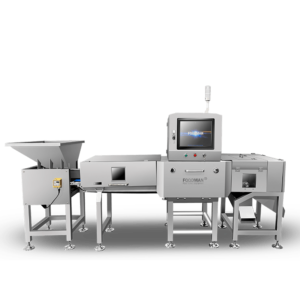
Meat processing brings together several inspection challenges at once: bones can resemble the surrounding product, fat distribution may vary considerably, and foreign materials can become concealed after cutting, forming, or packaging. Foodman Vision addresses this broader inspection field through technologies designed around density differences and image analysis. For processors, understanding how X-Ray imaging interacts with meat structure is more useful than focusing on detection claims alone, because product composition, package format, line speed, and hygiene conditions all influence inspection performance.
Why Meat Products Require Specialized Inspection
Bone fragments represent a distinctive concern in meat and poultry production because they may remain inside products after cutting or deboning. Their density differs from muscle tissue, giving X-Ray imaging a physical basis for identifying them. Glass, ceramics, stones, and certain dense plastics can also create detectable contrast, depending on their composition and the inspection setup.
Meat products rarely have perfectly uniform structures. Fat, connective tissue, moisture, and muscle appear differently in an X-Ray image, while products such as sausages, minced meat, poultry portions, and formed meat may vary considerably from batch to batch. Inspection algorithms therefore need to distinguish genuine foreign objects from normal variations in the product itself.
Packaging introduces another layer of complexity. Vacuum bags, trays, films, metalized materials, and cartons each contribute different background characteristics. Inspection parameters should consequently be established with representative samples rather than relying only on theoretical sensitivity values.
How X-Ray Imaging Supports Meat Safety
Inside an inspection tunnel, X-Rays pass through the product before reaching a detector. Differences in absorption create an image that can reveal objects hidden beneath the surface. Unlike visual inspection, the process does not depend on whether a contaminant can be seen from outside the package.
Food X-Ray machine technology becomes particularly useful where foreign-material risks extend beyond conventional metal detection. Bone, glass, ceramic, stone, and selected dense plastics may be detectable because their density differs from that of the surrounding food. Detection capability still depends on material properties, object size, product composition, and equipment configuration.
Image processing plays an important role in turning raw X-Ray information into an inspection result. Software evaluates patterns within the image and separates suspicious areas from expected product characteristics. Careful parameter adjustment helps control false rejects, which matters because unnecessary rejection can increase waste even though the inspection system itself remains technically functional.
Factors That Influence Bone Detection
Bone detection deserves special attention in poultry, pork, beef, and other meat applications. Bone thickness, orientation, product density, and surrounding tissue can all affect visibility. A small fragment positioned behind denser material may present a different inspection challenge from the same fragment located near the surface.
Dual-energy technology can provide additional information by comparing X-Ray responses at different energy levels. Easyweigh lists the FXR-BN30, FXR-BN40, and FXR-BN60 models within its dual-energy bone inspection range, with detector options down to 0.1 mm and published sensitivity figures including 1.0 mm for calcified bone and 2.0 mm for fan, rib, and wishbone detection.
Product movement also affects inspection results. Higher conveyor speeds shorten the available imaging time, while irregular product placement can change the thickness seen by the detector. Consequently, a food X-Ray machine should be evaluated using actual meat products, realistic production speeds, and the specific foreign objects relevant to the processing line.
Matching Equipment With Production Conditions
Hygiene requirements can be especially demanding in meat facilities because equipment may face moisture, frequent cleaning, and temperature fluctuations. Stainless-steel construction, suitable ingress protection, accessible conveyor areas, and an inspection tunnel designed for the working environment therefore deserve attention alongside detection specifications.
Production planning should extend beyond the machine itself. Reject mechanisms, conveyor dimensions, product orientation, package size, data connectivity, and cleaning procedures can all affect the practicality of an inspection installation. Meat processors may also need different settings for different recipes or package formats, making product presets and straightforward parameter management useful operational features.
Turning Inspection Data Into Better Process Control
Foreign-object inspection works most effectively as one part of a wider preventive food-safety program. Raw-material controls, equipment maintenance, hygienic handling, cutting procedures, packaging checks, and finished-product inspection address different points in the production chain. X-Ray inspection adds value by examining the product after contaminants may already have become hidden from ordinary visual checks.
Inspection records can also support process investigation. Repeated detections in a particular production period may prompt quality teams to examine upstream equipment, raw materials, cutting tools, or packaging components. Such information can help identify patterns instead of treating every rejected package as an isolated incident.
Selection should therefore begin with the actual product and production environment. Food X-Ray machine performance needs to be considered alongside meat density, package construction, contaminant type, throughput, hygiene conditions, and acceptable reject rates. With those factors clearly defined, Foodman Vision can serve as a reference within the wider range of X-Ray and vision inspection approaches available to meat processors.