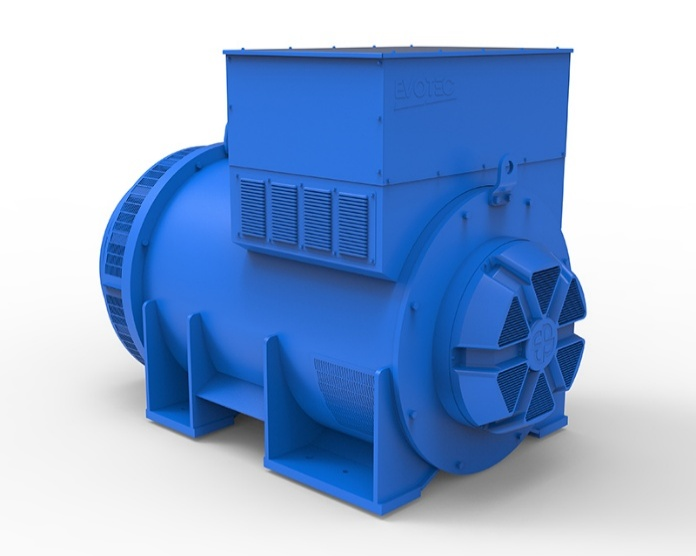
Alternator capacity alone does not determine voltage stability in a large industrial power system. Heavy equipment can change electrical demand within moments, while parallel alternators must respond together without creating unwanted reactive-power circulation. The automatic voltage regulator (AVR) is therefore a critical control element. It continuously monitors electrical conditions and adjusts excitation so the alternator can maintain voltage as operating conditions change.
For manufacturers, EPC contractors, and system integrators, understanding this control function is essential when selecting an alternator for a demanding industrial application. EvoTec Power supplies alternator units built with these control related performance requirements in mind.
AVR Turns Voltage Feedback Into Fast Excitation Control
The basic purpose of an AVR is straightforward: compare the actual terminal voltage with the target value and regulate excitation accordingly. The engineering challenge becomes much greater when the connected load changes rapidly.
A modern digital AVR works as a closed-loop control system. Electrical measurements are sampled, compared with the voltage reference, and converted into excitation commands. In high-performance designs, this control process is intended to react on very short time scales, including microsecond-level processing intervals in advanced digital architectures. The objective is not simply to restore voltage after a disturbance, but to limit the depth and duration of the deviation.
This matters because voltage stability directly affects motors, drives, transformers, contactors, and other industrial equipment. Poor control can produce nuisance trips, motor torque fluctuations, or unstable operation of sensitive processes.
Managing Sudden Heavy-Load Changes
Consider a steel plant with a large rolling mill. When a major motor-driven section accelerates or a heavy mechanical load enters the process, the electrical demand can rise sharply. The alternator terminal voltage may initially dip because the sudden current increase creates a transient voltage drop.
A well-tuned AVR responds by increasing excitation to support the magnetic field and recover the terminal voltage. The opposite problem can occur when a large inductive load is suddenly disconnected. Without appropriate regulation, stored system energy and changing reactive demand can contribute to a voltage overshoot.
Large compressors create similar challenges. Their operating cycle may produce significant changes in real and reactive power. The AVR must respond quickly while avoiding excessive correction that causes oscillation. In practice, voltage recovery therefore depends on both the alternator’s electromagnetic characteristics and the regulator’s control strategy.
For an industrial high power alternator, AVR performance should be evaluated together with the prime mover, excitation system, load profile, and transient requirements rather than treated as an isolated component.
Reactive Power Sharing in Parallel Operation
Large projects often use several alternators in parallel rather than relying on one machine. This arrangement can improve operational flexibility and provide additional capacity for maintenance or changing loads. However, parallel operation requires controlled sharing of reactive power.
Voltage droop is commonly used to establish a predictable relationship between reactive current and voltage reference. Correctly implemented droop control helps individual alternators share reactive current rather than competing to regulate the bus at exactly the same voltage. Stamford’s AVR documentation describes droop-current-transformer feedback as a method for achieving stable reactive-current sharing during parallel operation.
The practical benefit is important for industrial operators. Poorly coordinated excitation can cause one alternator to carry excessive reactive current while another contributes too little. That imbalance can increase heating and reduce the available capacity of the overall system. AVR settings must therefore be coordinated with the switchgear, synchronization controls, and system operating philosophy.
Protection Is Part of Voltage Stability
High-power alternator regulation is also a protection function. One important feature is overexcitation protection or limiting. Excessive excitation can increase rotor and field-system stress, particularly when the alternator experiences abnormal conditions or prolonged reactive demand.
Underfrequency behavior must also be considered. When the prime mover cannot immediately maintain speed during a major load increase, frequency may fall. An AVR with underfrequency roll-off can reduce excitation as frequency drops, helping prevent the alternator from being pushed beyond an appropriate operating condition while allowing the prime mover time to recover. Manufacturer AVR documentation identifies UFRO specifically as a control function associated with falling frequency.
EvoTec Power‘s digital AVR range includes ETC-1, ETC-2, and ETC-3. The company states that ETC-2 and ETC-3 provide parallel-operation functionality and overexcitation protection, while its digital AVR designs also incorporate frequency compensation, low-frequency protection, EMI filtering, and stability adjustment functions.
EVO568 for Demanding Industrial Power Systems
For projects requiring substantial electrical output, EvoTec Power’s EVO568 series is designed for large industrial applications. The official product specification lists a power range of 3,000/4,500 kVA, 400/480 V, 50/60 Hz, and 2/4/6/8/10 poles. Its continuous 50 Hz range is 3,000–3,750 kVA, while the specified 60 Hz continuous range is 3,600–4,500 kVA. The series adopts Class H insulation, a 2/3 winding pitch, and is fitted with the ETC-2 AVR featuring parallel-operation capability and over-excitation protection, with self-excitation or PMG available as excitation options.
The EVO568 is a viable option for systems where voltage performance under heavy, variable loads is a key selection consideration. For example, an OEM integrating an alternator into a large industrial power package needs to evaluate not only the continuous kVA requirement, but also motor starting events, reactive loading, parallel operation, and the control response required by the connected process.
Selecting the AVR as Part of the Whole System
AVR performance should never be judged from a voltage-regulation number alone. Engineers should examine transient response, excitation capability, droop settings, underfrequency behavior, overexcitation protection, excitation-system configuration, and compatibility with the prime mover and controls.
For a 3 MW-class application, the 3 mw generator requirement should therefore be translated into a complete alternator and control specification. EvoTec Power’s EVO568-series alternator supports multiple AVR options including the ETC-2 unit, which offers parallel-operation capability and over-excitation protection. Together with other configurable functions, this flexibility allows OEMs and project integrators to adapt the high power alternator to actual-site operating environment requirements.
Voltage stability entails fast, accurate responses to changing electrical conditions. The AVR is the control layer that connects alternator excitation with those changing conditions. By coordinating voltage regulation, reactive-power sharing, frequency response, and protection, a properly selected AVR helps a high-power alternator maintain predictable performance when industrial loads become difficult to control. For engineering teams working with EvoTec Power, this makes AVR selection an important part of designing a reliable power system rather than a final accessory choice.