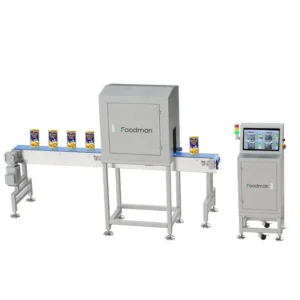
Freshly baked goods may look uniform from the outside, yet their internal structure can vary with ingredients, fillings, moisture, and processing methods. Flour and other raw materials can introduce stones or other unwanted materials, while machinery may contribute metal fragments during production. Food X-Ray machine technology gives bakery manufacturers a non-destructive method for examining products and packages for certain dense foreign objects. Foodman Vision operates in automated food inspection. Its systems combine X-ray and vision technology for different quality-control tasks.
Where Foreign Objects Can Enter Bakery Production
Contamination risks do not originate from one particular stage of baking. Raw ingredients may carry small stones, while worn processing components can introduce metal fragments. Glass and ceramic materials can also become concerns if breakage occurs around production or storage areas.
Product formulation adds another layer of complexity. Nuts, seeds, chocolate pieces, fruit, fillings, and other dense ingredients naturally appear inside many bakery products. Inspection systems therefore need to distinguish expected product structures from materials that should not be present.
Packaging can create additional challenges after baking. Bread, biscuits, cakes, pizza, and other products may be enclosed in plastic, paper, cartons, or metal-containing packaging. Easyweigh’s bakery-industry guidance notes that X-Ray inspection can be used for baked products in metal packaging, where conventional metal detection may have limitations.
How X-Ray Imaging Examines Baked Goods
X-Ray inspection relies on differences in material density. As X-Rays pass through food, packaging, and potential contaminants, different materials absorb different amounts of radiation. The detector converts these variations into an image that can then be analyzed by inspection software.
Food X-Ray machine performance is influenced by product thickness, density, package construction, contaminant composition, and conveyor speed. Thin biscuits and individually packed cookies create a different imaging background from filled cakes or boxed pizza. Consequently, inspection parameters need to reflect the characteristics of the products actually moving through the line.
Internal inspection can also provide information beyond foreign-object detection. Easyweigh describes bakery applications in which X-Ray systems can check product integrity, including whether biscuits are broken or whether certain filled products contain the expected internal structure.
Choosing Inspection Methods for Different Bakery Formats
Product format should influence the inspection configuration. Small packaged biscuits may require a compact conveyor arrangement, whereas larger cartons or products surrounded by dense packaging may call for a different scanning geometry. Product orientation matters too, since overlapping items can alter the thickness presented to the X-Ray beam.
Easyweigh lists its packaged-product X-Ray systems for bakery applications such as small packaged biscuits, bread, and cakes. Published specifications for the relevant packaged-product range include working speeds of 10–70 m/min, with listed sensitivity of 0.3 mm for stainless-steel balls, 0.2 × 2 mm for stainless-steel wire, and 1.0 mm for ceramic and glass.
Metal packaging deserves particular attention because it can change the inspection background. Easyweigh also describes single-beam and dual-beam configurations for products such as boxed pizza, metal-packaged cookies, cheese, and cake. Dual imaging can provide different viewing angles, while selected inspection areas can help avoid interpreting packaging components such as aluminum closures as contaminants.
X-Ray Inspection and Vision Technology
Not every bakery defect requires the same inspection method. X-Ray imaging examines density-related characteristics, while machine vision is better suited to visible attributes such as surface appearance, shape, labeling, coding, and sealing. Separating these functions helps manufacturers select technology according to the actual defect being investigated.
Food X-Ray machine systems can therefore complement camera-based inspection rather than replace it. A vision system may identify a damaged package or incorrect label, while X-Ray imaging can examine concealed foreign material or certain internal defects. Combining technologies can create broader inspection coverage without expecting one system to interpret every quality issue.
Production speed also needs consideration. Bakery lines often handle large volumes of relatively small products, so inspection equipment must match conveyor speed, spacing, reject timing, and downstream equipment. Easyweigh’s bakery application information also lists dynamic checkweighing alongside X-Ray inspection, reflecting the different quality-control functions that can operate within the same production environment.
Making Bakery Inspection More Practical
Inspection quality depends partly on how well the system fits the production process. Sample testing with actual recipes and packaging can reveal how ingredients, fillings, package thickness, and product orientation affect image quality. Such testing provides more useful information than relying on generic performance figures alone.
Process controls remain important even after an inspection system has been installed. Ingredient checks, equipment maintenance, sanitation, packaging control, and finished-product inspection address different contamination pathways. X-Ray inspection adds another checkpoint rather than replacing upstream preventive measures.
For bakery manufacturers assessing automated inspection, Foodman Vision offers a useful reference within Easyweigh’s wider technology portfolio. A suitable food X-Ray machine should be selected according to the product format, packaging, production speed, foreign-object risks, and inspection objectives. Careful matching of these factors makes X-Ray technology a practical part of bakery quality management rather than simply an additional machine on the production line.